
This piece was originally published on my Substack on September 25, 2025. If you’d like to follow my writing there, you can find me at mineralshaman.substack.com.

There’s a protocol circulating right now that tells people to take 200 to 400 mg of iron daily with high dose vitamin C and drive their serum ferritin to 125 ng/mL or above.

Thousands of people are doing it. Many of them report feeling better, at least at first. That’s the part that makes this hard to talk about, and it’s the part I want to take seriously rather than wave away.

Because they’re not lying about feeling better. The relief is real. It’s also, I think, the wrong kind of relief, produced by forcing a broken system rather than repairing it.

Start with the dose

The published version of the protocol scales by body weight. At 250 pounds, my range would be 113 to 567 mg of elemental iron per day.

Hold that against the actual requirement. A functioning body needs to absorb around 1 mg a day, because it recycles roughly 95 percent of the 25 mg it uses daily from red blood cells being broken down. The tolerable upper intake level for adults is 45 mg. The protocol’s upper end is more than twelve times that number, and by my own arithmetic represents somewhere between three months and two years of ordinary iron requirement taken in a single day.

I want that on the table before any of the mechanistic argument, because the mechanistic argument is where this gets interesting and the dose is where it gets dangerous.

The validation nobody else offered

Here’s why the protocol spreads.

You’ve spent years telling doctors you’re exhausted. Your hair is thinning. Your legs won’t stay still at night and your thinking feels muffled. They run labs, find nothing outside the reference range, and send you home.

Then someone points at your ferritin of 40 and tells you that’s the problem, that you’re severely deficient, that the doctors missed it.

That lands as recognition. After years of being told nothing is wrong, someone has finally said your suffering is real and physical and has a name. That feeling is powerful enough that most people never get around to examining the logic underneath it.

I don’t say that as a criticism of the people taking it. Being dismissed for years does something to a person, and I’d rather understand why a protocol spreads than sneer at the people it reached.

What the number was calibrated against

I went through this in detail in the last piece, so I’ll compress it here.

Serum ferritin became a clinical index of iron stores by correlating with Perls’ Prussian blue staining of bone marrow, which remains the reference standard today. And Prussian blue detects aggregated ferric deposits, which is to say hemosiderin, rather than iron dispersed inside intact ferritin.

So the marker was anchored to the degraded fraction, the iron that has already gone out of circulation and comes back reluctantly if at all.

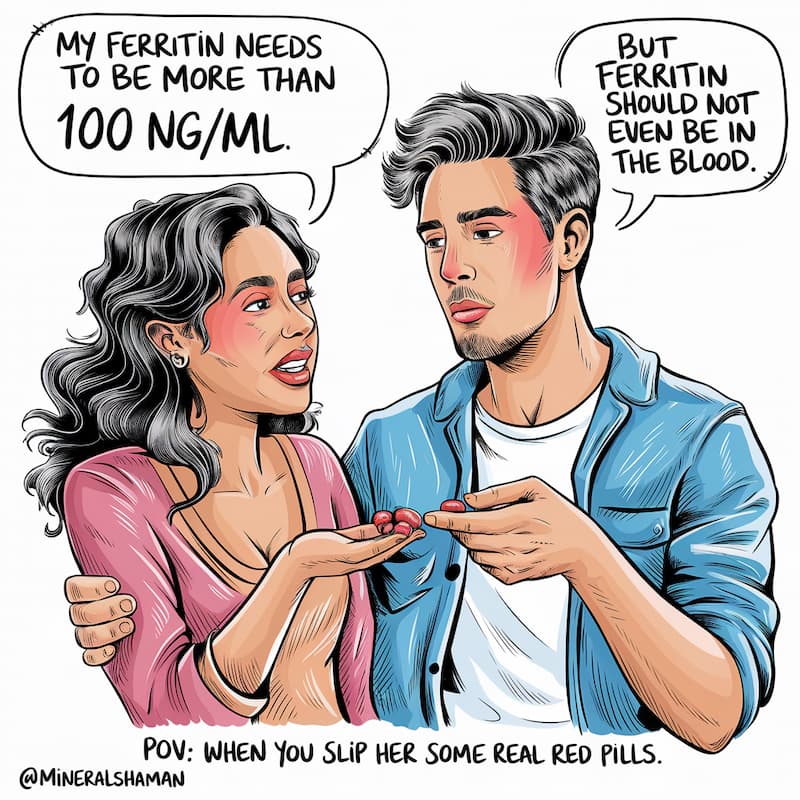
The Iron Protocol treats serum ferritin as the safe storage of excess iron and makes it the only number worth tracking. Cellular ferritin genuinely is safe storage. Serum ferritin is a different object with the same name. Kell and Pretorius argue it reaches the blood as a leakage product from cells that have been damaged, having dumped most of its iron along the way.

On that account, chasing a higher serum ferritin is chasing a higher rate of cellular leakage. Which is a strange thing to celebrate.

I’d add one honest caveat. Kell’s position implies that an undamaged system would leak nothing, so the theoretical ideal is near zero. That’s a statement about what the marker represents, not a clinical target, and I’d be careful with anyone who converts it into one. A serum ferritin of 20 to 50 tells you some cellular turnover is happening, which is normal. Read alongside transferrin saturation and ceruloplasmin, in someone whose copper status is sound, that range often sits with good function. Read alone, it tells you much less than people think.

The copper the protocol never mentions

Ceruloplasmin is the copper-dependent ferroxidase that loads iron onto transferrin. Without enough functional ceruloplasmin, iron doesn’t move, however much of it you have.

That produces a person who is iron loaded and functionally iron starved at the same time. The stores exist. The delivery system doesn’t work. Every conventional test that measures availability reads low, and the obvious intervention is more iron, which addresses nothing.

There’s also a defensive layer here worth understanding. Poorly chaperoned iron is dangerous iron, useful to pathogens and productive of oxidative stress, and the body responds to it by raising hepcidin. Hepcidin blocks ferroportin, which is the only exit iron has from a cell. That’s ancient immune logic: lock the iron away and starve whatever is trying to use it.

The cost is that the same lock keeps iron from your own recycling machinery. Macrophages that should be handing iron back to circulation can’t release it.

Why the relief is real

This is the mechanism I think explains why people feel better on the protocol, and it isn’t flattering to the protocol.

Someone with elevated hepcidin has iron they cannot reach. They take a very large iron dose with high dose vitamin C. Ascorbate improves absorption substantially, and some iron gets through. It reaches tissue. They feel the difference, and the difference is genuine.

What hasn’t changed is why hepcidin was elevated. The delivery problem is untouched. Meanwhile total body iron burden goes up, oxidative stress goes up, and cellular damage goes up, which is exactly what pushes serum ferritin from 15 toward 125.

The rising number gets read as a deficiency being corrected. Under Kell’s account it’s a damage signal getting louder.

The protocol also dismisses transferrin saturation as useless, which is the one marker that would tell you when the transport system is saturated and iron is circulating without a chaperone. Discarding it isn’t simplification. It’s removing the smoke detector because it keeps going off.

The plumbing

An old house has corroded pipes and poor flow. A plumber turns the pressure up until water forces through.

Flow improves. Everyone’s happy. And the pipes are being destroyed from the inside, on a schedule nobody is watching.

That’s the shape of it. Force iron through a transport system that isn’t working, get real short term relief, and leave the reason it wasn’t working entirely untouched.

What I did instead

I went the other direction, and it was slower than I wanted.

Restoring bioavailable copper came first, so that iron already in my body could be mobilized and recycled. Blood donation offloaded the surplus gradually. My serum ferritin came down from over 150 to somewhere in the twenties, and over that same stretch my energy came back, my thinking cleared, and symptoms that had been with me for years let go.

The Iron Protocol would read that ferritin as evidence of a disaster. I’d read it as a system that stopped leaking.

I want to be careful about how much weight that carries. It’s one person over about five years, I was doing several things at once, and I can’t separate the copper work from the donations from everything else I changed. It persuaded me. It shouldn’t persuade you on its own.

The shared error

The Iron Protocol makes the same mistake as the medicine it defines itself against, running in the opposite direction. Both treat the marker as the thing. One says your ferritin is normal so nothing is wrong. The other says your ferritin is low so take iron until it isn’t.

Neither asks why the number is where it is, or whether the number measures what everyone assumes it measures.

Iron balance isn’t a target value. It’s a question about whether copper-dependent regulation is intact, and you can’t answer that by moving a single number until it looks better.

If the thing you’re hunting for is already in your hand, acquiring more of it won’t help. The question is why you couldn’t feel it.


Share This Post

When the Cure Becomes the Cause

This piece was originally published on my Substack on September 25, 2025. If you’d like to follow my writing there, you can find me at mineralshaman.substack.com.

There’s a protocol circulating right now that tells people to take 200 to 400 mg of iron daily with high dose vitamin C and drive their serum ferritin to 125 ng/mL or above.

Thousands of people are doing it. Many of them report feeling better, at least at first. That’s the part that makes this hard to talk about, and it’s the part I want to take seriously rather than wave away.

Because they’re not lying about feeling better. The relief is real. It’s also, I think, the wrong kind of relief, produced by forcing a broken system rather than repairing it.

Start with the dose

The published version of the protocol scales by body weight. At 250 pounds, my range would be 113 to 567 mg of elemental iron per day.

Hold that against the actual requirement. A functioning body needs to absorb around 1 mg a day, because it recycles roughly 95 percent of the 25 mg it uses daily from red blood cells being broken down. The tolerable upper intake level for adults is 45 mg. The protocol’s upper end is more than twelve times that number, and by my own arithmetic represents somewhere between three months and two years of ordinary iron requirement taken in a single day.

I want that on the table before any of the mechanistic argument, because the mechanistic argument is where this gets interesting and the dose is where it gets dangerous.

The validation nobody else offered

Here’s why the protocol spreads.

You’ve spent years telling doctors you’re exhausted. Your hair is thinning. Your legs won’t stay still at night and your thinking feels muffled. They run labs, find nothing outside the reference range, and send you home.

Then someone points at your ferritin of 40 and tells you that’s the problem, that you’re severely deficient, that the doctors missed it.

That lands as recognition. After years of being told nothing is wrong, someone has finally said your suffering is real and physical and has a name. That feeling is powerful enough that most people never get around to examining the logic underneath it.

I don’t say that as a criticism of the people taking it. Being dismissed for years does something to a person, and I’d rather understand why a protocol spreads than sneer at the people it reached.

What the number was calibrated against

I went through this in detail in the last piece, so I’ll compress it here.

Serum ferritin became a clinical index of iron stores by correlating with Perls’ Prussian blue staining of bone marrow, which remains the reference standard today. And Prussian blue detects aggregated ferric deposits, which is to say hemosiderin, rather than iron dispersed inside intact ferritin.

So the marker was anchored to the degraded fraction, the iron that has already gone out of circulation and comes back reluctantly if at all.

The Iron Protocol treats serum ferritin as the safe storage of excess iron and makes it the only number worth tracking. Cellular ferritin genuinely is safe storage. Serum ferritin is a different object with the same name. Kell and Pretorius argue it reaches the blood as a leakage product from cells that have been damaged, having dumped most of its iron along the way.

On that account, chasing a higher serum ferritin is chasing a higher rate of cellular leakage. Which is a strange thing to celebrate.

I’d add one honest caveat. Kell’s position implies that an undamaged system would leak nothing, so the theoretical ideal is near zero. That’s a statement about what the marker represents, not a clinical target, and I’d be careful with anyone who converts it into one. A serum ferritin of 20 to 50 tells you some cellular turnover is happening, which is normal. Read alongside transferrin saturation and ceruloplasmin, in someone whose copper status is sound, that range often sits with good function. Read alone, it tells you much less than people think.

The copper the protocol never mentions

Ceruloplasmin is the copper-dependent ferroxidase that loads iron onto transferrin. Without enough functional ceruloplasmin, iron doesn’t move, however much of it you have.

That produces a person who is iron loaded and functionally iron starved at the same time. The stores exist. The delivery system doesn’t work. Every conventional test that measures availability reads low, and the obvious intervention is more iron, which addresses nothing.

There’s also a defensive layer here worth understanding. Poorly chaperoned iron is dangerous iron, useful to pathogens and productive of oxidative stress, and the body responds to it by raising hepcidin. Hepcidin blocks ferroportin, which is the only exit iron has from a cell. That’s ancient immune logic: lock the iron away and starve whatever is trying to use it.

The cost is that the same lock keeps iron from your own recycling machinery. Macrophages that should be handing iron back to circulation can’t release it.

Why the relief is real

This is the mechanism I think explains why people feel better on the protocol, and it isn’t flattering to the protocol.

Someone with elevated hepcidin has iron they cannot reach. They take a very large iron dose with high dose vitamin C. Ascorbate improves absorption substantially, and some iron gets through. It reaches tissue. They feel the difference, and the difference is genuine.

What hasn’t changed is why hepcidin was elevated. The delivery problem is untouched. Meanwhile total body iron burden goes up, oxidative stress goes up, and cellular damage goes up, which is exactly what pushes serum ferritin from 15 toward 125.

The rising number gets read as a deficiency being corrected. Under Kell’s account it’s a damage signal getting louder.

The protocol also dismisses transferrin saturation as useless, which is the one marker that would tell you when the transport system is saturated and iron is circulating without a chaperone. Discarding it isn’t simplification. It’s removing the smoke detector because it keeps going off.

The plumbing

An old house has corroded pipes and poor flow. A plumber turns the pressure up until water forces through.

Flow improves. Everyone’s happy. And the pipes are being destroyed from the inside, on a schedule nobody is watching.

That’s the shape of it. Force iron through a transport system that isn’t working, get real short term relief, and leave the reason it wasn’t working entirely untouched.

What I did instead

I went the other direction, and it was slower than I wanted.

Restoring bioavailable copper came first, so that iron already in my body could be mobilized and recycled. Blood donation offloaded the surplus gradually. My serum ferritin came down from over 150 to somewhere in the twenties, and over that same stretch my energy came back, my thinking cleared, and symptoms that had been with me for years let go.

The Iron Protocol would read that ferritin as evidence of a disaster. I’d read it as a system that stopped leaking.

I want to be careful about how much weight that carries. It’s one person over about five years, I was doing several things at once, and I can’t separate the copper work from the donations from everything else I changed. It persuaded me. It shouldn’t persuade you on its own.

The shared error

The Iron Protocol makes the same mistake as the medicine it defines itself against, running in the opposite direction. Both treat the marker as the thing. One says your ferritin is normal so nothing is wrong. The other says your ferritin is low so take iron until it isn’t.

Neither asks why the number is where it is, or whether the number measures what everyone assumes it measures.

Iron balance isn’t a target value. It’s a question about whether copper-dependent regulation is intact, and you can’t answer that by moving a single number until it looks better.

If the thing you’re hunting for is already in your hand, acquiring more of it won’t help. The question is why you couldn’t feel it.

Share This Post

More To Explore