When Mystical Language Stops Communicating
Recognizing word salad in alternative health
This piece was originally published on my Substack on September 12, 2025. If you’d like to follow my writing there, you can find me at mineralshaman.substack.com.
I’ve stepped back from most of the online healing conversation, which has been good for me. But I keep noticing one thing from a distance, and it’s worth naming.
A lot of health writing has stopped explaining anything.
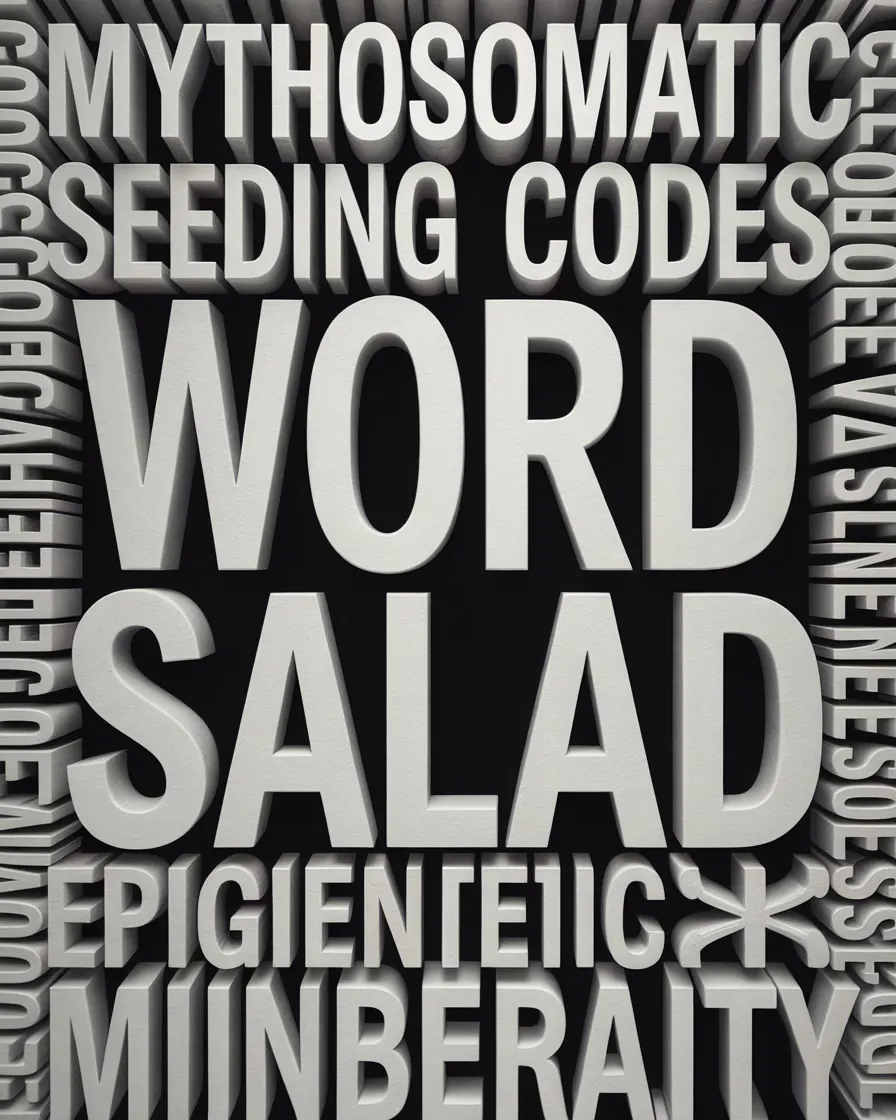
Word salad began as a psychiatric term. It describes language that has the shape of meaning without the content. That’s a clinical usage and I’m borrowing it loosely, because what I’m describing isn’t a symptom. It’s a style. Scientific vocabulary braided with mystical vocabulary until the sentence sounds substantial and can’t be checked, restated, or acted on.
Here’s the mechanism that makes it work on people. When you can’t follow what someone with credentials is saying, you tend to assume the gap belongs to you. Most of us are trained into that assumption early and never examine it. So confusion, which should be a signal to ask a question, gets experienced as a personal deficiency instead.
Let me work from an example. I recently came across promotional copy for a workshop on mental health, minerality, and the mythic body, priced at one hundred twenty dollars. I’m using it because it’s public and because it’s unusually concentrated, not because the person who wrote it is worse than anyone else. The pattern is everywhere and it’s usually more diluted than this.
Consider the phrases. Tending the epigenetic field is depth work. Seeding codes of creation. Methylation through the mythic lens.
I want to be careful here, because there’s a version of this criticism that’s just philistinism. Specialized vocabulary isn’t a problem. Every discipline has it, and mythopoetic language does real work that plain language cannot. The question isn’t whether a phrase is unusual. It’s whether the person using it can unfold it on request. Depth psychology can define depth work. Epigenetics can define what it studies. Tending the epigenetic field, as a combined phrase, doesn’t obviously belong to either vocabulary, and I don’t know what would count as doing it or failing to do it.
That last part matters more than the strangeness. If I can’t tell what would count as doing the thing, the phrase isn’t giving me information.
The depth framing carries a second problem. If tending the epigenetic field is depth work, then whatever the reader is currently doing is implicitly shallow. That implication does its work whether or not anyone intended it, and it arrives before the reader has been given anything they could use to evaluate the claim.
Now a harder example, because I don’t want to stack the deck. From the same copy: “Common methylation discourse frames genetic SNPs as evolutionary errors, yet evolutionary biology suggests ubiquitous variants like MTHFR wouldn’t persist without being neutral or beneficial.”
This one isn’t empty. There’s a real argument in population genetics that a variant this common is unlikely to be simply deleterious, and there’s genuine published debate about whether MTHFR C677T has been maintained by balancing selection. I actually think the underlying point deserves more attention than it gets, and the reflexive framing of every SNP as damage has done real harm to people’s peace of mind.
My problem with the sentence is narrower. It presents a contested question as a settled finding, attributes it to evolutionary biology as though the field speaks with one voice, and offers the reader a reframe rather than an argument. Someone anxious about their MTHFR result comes away feeling better without knowing anything more than they did before. Relief is not the same as understanding, and a person who has been relieved rather than informed is in a worse position to evaluate what comes next.
Then there’s this: “Through methylation, ancestral inheritance converges with our metabolic health and molecules of emotion, influencing processes of individual and collective myth making.”
Methylation and metabolic health are real. Molecules of emotion is borrowed from Candace Pert and means something specific in her work, though not what it appears to mean here. Collective myth making is undefined. And the verbs are doing no work. Converges with. Influencing processes of. Strip the sentence down and you find a claim that several things are related in an unspecified way, which is not a claim at all.
The line I keep returning to is: science without story is just an idea. It’s memorable and it sounds generous. But read plainly, it demotes the scientific method to a notion pending narrative, which gets the relationship backwards. Story is how we hold and transmit findings. It isn’t what makes them true.
I want to be fair about intent, because I can’t establish it and it isn’t necessary to my point. Some of this language is almost certainly sincere. It’s entirely possible that these phrases mean something rich and specific to the person who wrote them, assembled over years of study, and that the compression is a failure of translation rather than a strategy. That possibility doesn’t rescue the outcome. A reader who can’t tell what a phrase means, and who blames themselves for it, is worse off in exactly the same way regardless of what was going on behind the sentence.
What the outcome does produce, reliably, is a particular kind of relationship. Language that can’t be unfolded positions its author as the only person who can unfold it. Whether or not anyone planned that, it’s a dependency, and it’s usually one you have to pay to maintain.
I’m also not arguing against the mythic or the spiritual. I’m about as deep in that territory as a person can be, and I think we badly need it. What I’m arguing is that rigor and depth aren’t in tension. If anything, the traditions I respect most are the ones that can say plainly what they’re doing.
Clear health communication is not a mystery. Define your terms. Show the reasoning behind a recommendation. Say where the evidence is thin and where you’re speculating. Leave room for questions. Instead of tending the epigenetic field, a practitioner might say that diet, stress, and sleep influence how genes get expressed, and then walk through what to do about each. The information survives the translation. What doesn’t survive it is the mystique.
So here’s the test I’d offer, and it costs nothing to run. Ask what a phrase means. A good practitioner will be glad you asked and will have an answer that makes the idea more available to you, not less. If the answer produces more fog than the question did, you’ve learned something worth knowing.