
This piece was originally published on my Substack on September 22, 2025. If you’d like to follow my writing there, you can find me at mineralshaman.substack.com.
You know the feeling of hunting for your keys through the whole house, the car, the junk drawer you avoid, the couch cushions, and then sitting down defeated with your hand on your forehead and finding them in the hand you’ve been searching with. That’s roughly how I felt looking at my blood donation records.
Twenty-seven donations across four and a half years. Roughly 266 mg of iron out with each one. About 7,195 mg total.
Every textbook puts total body iron in an adult male at around 4,000 to 5,000 mg. I’ve given away close to twice that, and my iron status stays elevated enough that I’m back every two months.
The first conclusion I jumped to was that the textbooks must be wrong. That conclusion was too fast, and working out why turned out to be more interesting than the original claim.
Why the number isn’t a paradox
Cumulative donation totals don’t measure how much iron you were carrying. They measure how much came out over time, and iron keeps coming in the entire time.
That’s not a small correction. Dietary absorption isn’t fixed. Hepcidin governs it, and hepcidin falls when erythropoiesis is driven hard. Repeated blood loss does exactly that. Low hepcidin leaves ferroportin open, which means more iron crossing out of the duodenum and more released from macrophages. Donating every eight weeks holds hepcidin down more or less permanently, so every donation quietly turns up the intake dial.
Run it. Say I take in 15 mg of iron a day, which is unremarkable in a fortified food supply, and absorb 15 percent of it while donating regularly. That’s a little over 2 mg a day, roughly 800 mg a year, and something like 3,600 mg across four and a half years. Add whatever I was actually carrying when I started, and the 7,195 mg stops needing an exotic explanation.
This is well understood in hemochromatosis care, where people routinely have far more iron removed over years of phlebotomy than their bodies could have held at any single moment. Nobody treats that as a paradox. It’s what happens when you drain a tank that’s still being filled.
So the donation total, by itself, proves nothing about hidden stores. I want to be clear about that, because I originally wrote this piece as though it did.
A word about the marker everyone reaches for
Before going further I have to deal with serum ferritin, because most of this conversation gets conducted in a unit that doesn’t mean what people think it means.
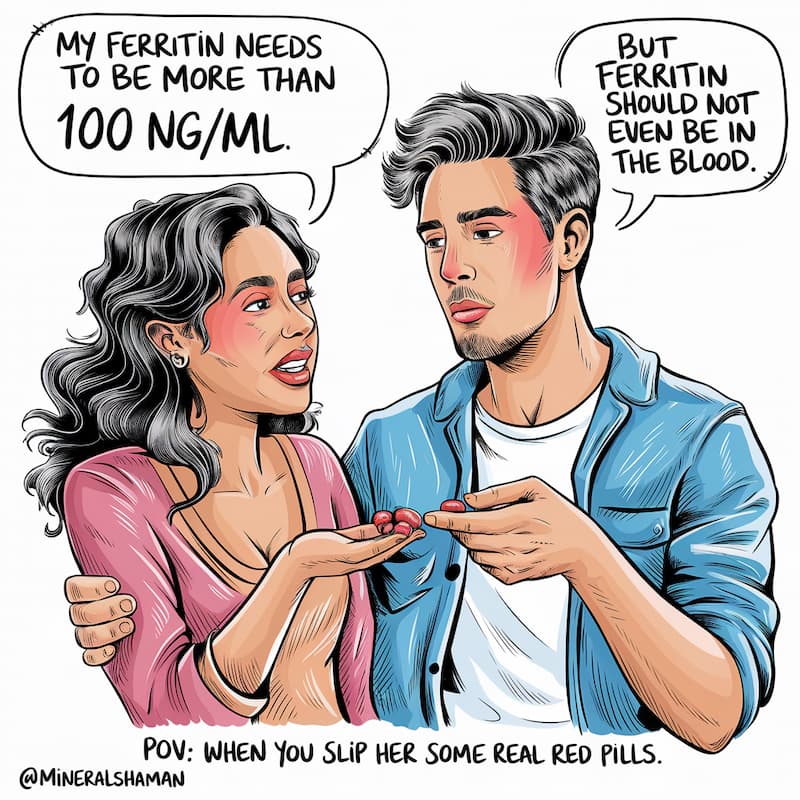
Ferritin is an intracellular protein. It isn’t synthesized in serum, and yet serum is where we measure it. Kell and Pretorius worked through that paradox in 2014 and concluded that serum ferritin arrives in the blood as a leakage product from damaged cells rather than as a controlled release from a storage depot, and that the protein has dumped most of its iron by the time it gets there. What we’re measuring, on that account, is cellular damage.
Now ask what the measurement was ever validated against.
The answer is stainable bone marrow iron. Serum ferritin earned its place as an index of iron stores by correlating with Perls’ Prussian blue staining of marrow aspirates, and that stain is still described as the gold standard for assessing iron stores in studies published this decade. Which raises the question nobody seems to ask out loud: what does Prussian blue actually stain?
It stains aggregated ferric deposits. Hemosiderin. Iron dispersed inside intact ferritin isn’t what lights up under light microscopy. The granules you see are the insoluble, degraded, poorly mobilizable fraction.
So the marker was anchored, from the beginning, to the iron that’s hardest to get back. Not to the working pool. Not to what’s available for hemoglobin synthesis or enzyme function tomorrow morning. The entire clinical apparatus reads a rising ferritin as rising available iron, when the standard it was calibrated against was a stain for the iron that has already gone out of circulation.
That inversion explains something that otherwise looks like a contradiction. A person can carry a comfortable ferritin number and still be unable to find iron for the jobs that need it. The number is reporting on the basement, not the shelf.
I’ll be fair to the other side of this. Serum ferritin does correlate with iron burden, and Kell doesn’t dispute that. He argues the correlation falls out of chemical kinetics rather than from serum ferritin being a storage readout. More loading means more cellular stress means more leakage. The number moves with the problem without being a measure of the problem. Inflammation, liver damage, and infection push it up on their own, which is why a single value carries far less information than the confidence around it suggests.
What I’d rather look at is transferrin saturation and serum iron, with ceruloplasmin alongside them.
The question that’s actually interesting
Here’s what the number doesn’t explain away. I’m donating at the maximum frequency allowed and my iron markers haven’t settled in four and a half years.
The first thing worth ruling out is the standard one, and I’ve ruled it out. I’ve been tested for the HFE mutations behind hereditary hemochromatosis and I don’t carry them. Whatever is holding my iron up, it isn’t the genetic explanation that would otherwise account for all of this.
Two things could produce that. Intake that keeps pace with removal, which the arithmetic above says is entirely plausible. Or iron that’s present but not participating, so the stores that matter clinically don’t come down even as blood leaves.
I think both are happening, and the second one is where the mineral story gets useful.
Where iron goes when there’s too much of it
Your body needs about 25 mg of iron a day. It recycles roughly 95 percent of that from red blood cells being broken down by macrophages, which is why you only need to absorb around 1 mg a day from food to stay even. It’s a closed loop with a small top-up.
Keep the top-up running at ten or twenty times what the loop requires, for decades, and the surplus has to go somewhere.
Ferritin is the organized version of storage. An adult male holds maybe 600 to 1,000 mg there, accessible and well managed. When ferritin is saturated, the overflow becomes hemosiderin, which is a different thing: an insoluble complex of ferritin and degraded ferritin and other material, deposited in tissue rather than circulating.
The standard description of hemosiderin iron is that it is, at best, very poorly available when the body needs it. That’s the part that matters here. Hemosiderin is not a reserve. It’s a place iron goes and mostly stays.
Parking is the analogy I keep coming back to. Ferritin is the marked spaces in the lot. Hemosiderin is what happens when the lot fills and cars end up on the shoulder, in the vacant lot, halfway across somebody’s driveway. Official capacity never changed. Actual accumulation is much larger. And the cars in the strange places are close to impossible to get out when you need one.
The copper part
Copper isn’t a bystander here. Ceruloplasmin, which carries most of the copper in your blood, is a ferroxidase, and iron cannot be loaded onto transferrin and moved without that oxidation step.
Without functional ceruloplasmin, iron gets stuck. You end up in the position of holding substantial iron while being unable to use it, which reads on paper as iron deficiency and gets treated with more iron.
This is the situation I think a lot of people are actually in. Not iron deficient. Iron immobile. And the standard response to a low iron panel makes it worse.
Supporting bioavailable copper status is what changed things for me, more than the donations did. That’s also the part I can’t demonstrate from my own records, and I’d rather say so than pretend otherwise.
The fortification arithmetic
A single serving of fortified cereal often carries 18 mg of iron, which is the full RDA. Bread, pasta, and everything else built from enriched flour add more. Against a genuine daily requirement of about 1 mg absorbed, the surplus is not marginal.
American flour enrichment began in 1941. In 1974 the National Academy of Sciences recommended raising iron levels and the FDA did. Intakes among young men climbed, concerns about excess followed, and in 1977 the FDA lowered the standards again. The regulators found the ceiling themselves in about three years.
We’ve been running a population-scale iron experiment since before anyone alive was eating solid food, and the copper side of the equation has moved in the opposite direction the entire time.
What I’d actually claim
My donation total isn’t evidence of anything on its own. I said otherwise when I first wrote about this, and the correction is worth more than the original claim was.
What I’d defend is narrower. Iron status that won’t normalize under maximal phlebotomy points at intake, mobilization, or both. Hemosiderin is a real destination for surplus iron and a poor source of it. Copper status governs whether iron moves at all. And a person can carry a great deal of iron while functioning as though they have none, which is a situation that iron supplementation makes worse rather than better.
That’s less dramatic than a paradox. It also has the advantage of being true.
I’ve spent about five years watching this play out in one body, which is a sample size of one and I know it. Take it as a hypothesis worth testing rather than a finding.
References
Kell, D. B. (2009). Iron behaving badly: inappropriate iron chelation as a major contributor to the aetiology of vascular and other progressive inflammatory and degenerative diseases. BMC Medical Genomics, 2(1), 2.
Kell, D. B., & Pretorius, E. (2014). Serum ferritin is an important inflammatory disease marker, as it is mainly a leakage product from damaged cells. Metallomics, 6(4), 748-773.
Lipschitz, D. A., Cook, J. D., & Finch, C. A. (1974). A clinical evaluation of serum ferritin as an index of iron stores. New England Journal of Medicine, 290, 1213.
Lahtiharju, T., et al. (2025). Ferritin outperforms other biomarkers in predicting bone marrow iron stores in patients with hematologic disorders. Blood Advances, 9(7), 1608.
Institute of Medicine. Overview of food fortification in the United States and Canada. In Dietary Reference Intakes: Guiding Principles for Nutrition Labeling and Fortification (2003).