
What’s Actually in Tattoo Ink

A mineral perspective on what we put under the skin

Originally published October 3, 2024. Revised.

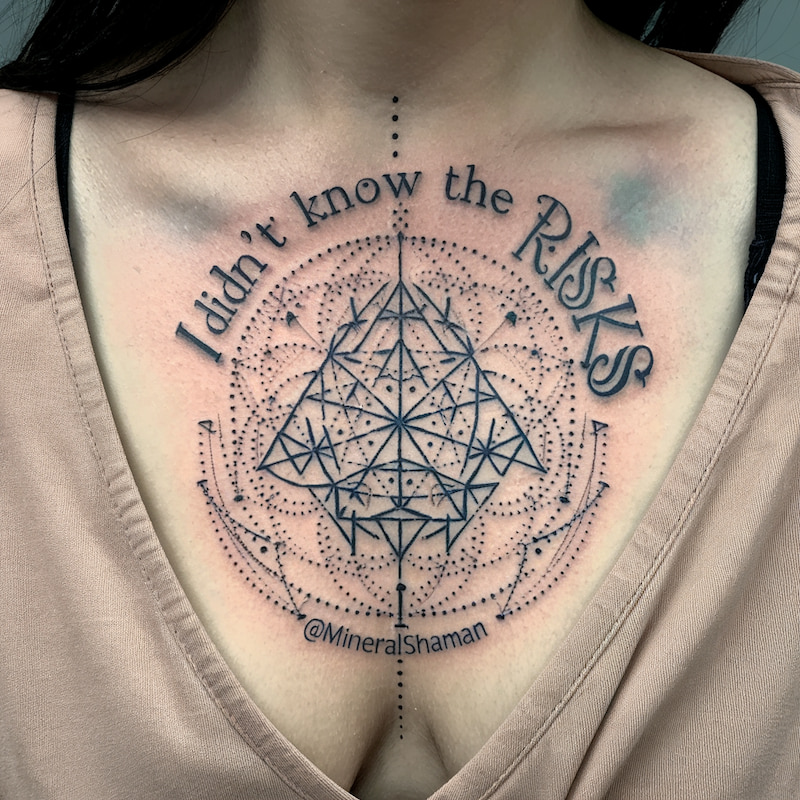
Tattoo ink is really two things working together: a pigment, and a carrier that holds the pigment in suspension long enough to get it under the skin. The carrier is usually some combination of water, ethanol, and witch hazel, and it mostly evaporates or gets absorbed in the days after. The pigment is the part that stays, for the rest of your life, which is the whole point of a tattoo and also the reason it’s worth knowing what you’re actually choosing.

Pigments fall into two broad categories, organic and inorganic, and the word organic is worth pausing on because the industry has discovered it and started using it in marketing. In chemistry, organic simply means the molecule contains carbon. That’s the entire definition. It says nothing about whether a compound came from a plant and nothing about whether it’s safer than the alternative. Some of the most reliably inert pigments in the trade are inorganic minerals, and plenty of organic pigments are synthetic compounds originally developed for industrial paint.

One useful tool for cutting through this is the Color Index, an international system that assigns a number to each colorant used across textiles, plastics, cosmetics, and inks. A manufacturer who lists CI numbers is telling you something real. CI 77891 is titanium dioxide. CI 77266 is carbon black, the basis of most black ink. CI 74160 is copper phthalocyanine, the standard bright blue. CI 73915 is a quinacridone magenta, also known as Pigment Red 122. CI 12475 is a naphthol red.

Chroma lists CI numbers on its safety data sheets, and so does Kurosumi, which deserves some credit. But it’s also less than it sounds like. A CI number identifies the primary colorant. It doesn’t tell you the ratios, the carrier formulation, the preservatives, or what came along for the ride as a manufacturing contaminant. You get the headline, not the full ingredient list.

Other brands offer even less. Luna markets organic pigments without saying which ones, and given what organic actually means, that phrase carries almost no information. Panthera claims proprietary fruit-derived pigments while listing hexane on its safety sheet, and since hexane is a common solvent for pulling oils out of plant material, the two claims are at least consistent with each other. Consistent is not the same as verified, though, and there’s no way to check further from the outside.

Then there’s what shows up when someone actually measures the stuff.

A team at Ege University in Turkey ran a set of tattoo inks through ICP-MS and published the results in Chemical Research in Toxicology. They found aluminum ranging from 1,191 to 3,425 mg/kg. Copper ran from 1.24 all the way up to 2,523. Iron came in between 17 and 318, zinc between 2.6 and 47, nickel between 0.63 and 17.5, and cobalt under 1.1.

Two things stand out about that study. The copper spread is the number I keep coming back to, because a factor of two thousand between the lowest and highest samples means there’s effectively no such thing as a typical tattoo ink. You’re not choosing a category when you pick a color, you’re choosing a specific bottle with its own chemistry. The other thing worth flagging is the sample size. This covered green, black, and red inks from three brands, which is a real signal and not a survey of the market, and anyone citing it as though it characterizes tattoo ink in general is overreaching.

The aluminum figure is the one that gets quoted most, and it usually gets quoted in a way that doesn’t quite hold up.

You’ll see the claim that these levels run higher than what’s in an aluminum-adjuvanted vaccine, and that comparison doesn’t actually work as stated, because it puts a concentration next to a dose. Milligrams per kilogram is not the same unit as milligrams. A vaccine adjuvant typically runs somewhere between 0.125 and 0.85 mg of aluminum per dose. Ink at 3,425 mg/kg works out to about 3.4 mg per gram of ink. So the honest comparison depends on how many grams actually went into the tattoo, and for a large piece the total could plausibly exceed a vaccine dose, maybe by a wide margin. That’s a real observation, but it’s a different one than the original claim, and it only holds up once you do the arithmetic instead of setting two unlike numbers side by side.

What matters more than the total, though, is the route the mineral takes into the body. Dietary minerals pass through the gut, where absorption is regulated and a good deal of what you swallow never makes it into circulation at all. Tattoo pigment skips that step entirely. It’s deposited straight into the dermis and stays there, in direct contact with living tissue, for decades. That’s not a form of exposure we have particularly good models for, because almost nothing else works this way.

Aluminum is where I want to slow down, because the mechanism underneath the concern is more interesting, and more specific, than the shorthand it usually gets reduced to.

A common way this gets framed is the body mounting an antibody response to aluminum, primed by an earlier exposure and triggered again by the ink. That framing doesn’t survive contact with how the immune system actually works, but the reason it fails matters more than the framing itself.

Aluminum does provoke the immune system, directly and by design. That’s the entire reason it works as a vaccine adjuvant in the first place. Aluminum particles get taken up by phagocytes, destabilize the lysosome, and activate the NLRP3 inflammasome, which drives release of interleukin-1 beta. They also kill some cells at the deposition site, spilling host DNA and uric acid that the immune system reads as danger signals, and inflammatory monocytes show up in response. None of that requires anything else in the vial. The innate immune system is reacting to the metal itself.

What doesn’t happen is antibody production against aluminum. Antibodies require an antigen that can be broken into peptides and displayed on MHC, and a bare metal ion can’t be processed that way.

Here’s the part worth sitting with, though, because I think it’s the more important half of the argument. That absence isn’t reassuring. It’s closer to the actual problem.

The body clears what it can recognize, and it regulates the metals it actually needs through dedicated systems. Iron has transferrin, ferritin, and hepcidin working together to manage it. Copper has ceruloplasmin and its own transporters. Aluminum has none of this, because nothing in our evolutionary history ever called for it. It isn’t part of the human metallome, and there’s no system whose job is getting it back out once it’s in.

So instead it moves through the body by a kind of mistaken identity. Aluminum’s ionic radius happens to be close enough to ferric iron that it binds the iron-binding sites on transferrin, and most of what circulates travels that way. Transferrin then does exactly what it’s built to do and delivers its cargo into cells through receptor-mediated uptake, including across the blood-brain barrier, where transferrin receptors are especially dense. A transport system that evolved for an essential metal ends up importing one the body can’t use and has no route to remove.

The strongest evidence that this actually accumulates comes from a different line of research than the autopsy studies, and it doesn’t depend on them at all. Davenward and colleagues had people drink up to a litre a day of silicon-rich mineral water for twelve weeks and tracked what showed up in urine. Aluminum excretion rose. Iron and copper excretion didn’t move, which tells you the effect was specific to aluminum rather than some general flushing of minerals. And the rise showed up in the healthy control group too, made up of the patients’ own carers and partners, not only in people with a diagnosis. Ordinary people with no notable exposure history were apparently carrying a mobilizable aluminum burden they didn’t know about. Jones and colleagues later reproduced the same effect in people with secondary progressive multiple sclerosis.

That strikes me as a cleaner argument than anything you could get from brain tissue at autopsy, because it tests the retention question directly, while the person is alive. If aluminum were clearing efficiently on its own, there would be nothing left for silicic acid to go mobilize.

There’s also a path back into adaptive immunity that supports the underlying sensitization concern, even once the antibody framing is set aside. Metals can form haptens, binding to self-proteins and creating something the T-cell repertoire reads as foreign. That’s the well-established mechanism behind nickel and cobalt contact allergy, and it runs on exactly the pattern you’d expect: an early exposure primes the immune system, and a later one triggers a reaction. Aluminum does this less often than nickel does, but persistent itching nodules and granulomas at aluminum-adjuvanted injection sites are documented in the literature. The reaction is real, and it’s specific to aluminum. It’s T-cell mediated rather than antibody mediated, which changes what you’d look for if you wanted to study it, but not whether it happens.

I want to be specific about sourcing here rather than waving vaguely at controversy, since that’s a fair thing to ask for. Christopher Exley’s work draws real criticism, and some of it holds up. His 2018 autism brain study used only five donors, with no age-matched comparison group measured alongside them, retained an extreme statistical outlier without investigating it, and produced high values that didn’t replicate in repeat samples taken from the same donors. Those are legitimate methodological objections, and I wouldn’t build an argument on that particular paper. The silicic acid excretion work sits in a different category. It has a control group, a specific effect that shows up consistently, a plausible mechanism, and independent replication in a second condition. That’s the part of his output worth leaning on.

Alongside it sits work that has nothing to do with him at all. Gherardi’s group in France documented aluminum hydroxide persisting at vaccination sites for years, with a characteristic histological signature, which is worth reading next to the excretion studies as a second, independent line of evidence for biopersistence.

None of this proves anything specific about tattoos. What it establishes is a chain: a metal with no biological role, no clearance pathway, and a documented capacity to sensitize the immune system is being placed permanently into the dermis in milligram quantities, and essentially nobody has studied what happens over the following decades.

The pigment doesn’t stay put where it’s placed, either. Schreiver and colleagues used synchrotron X-ray fluorescence to map tattooed skin alongside the draining lymph nodes, and found pigment particles that had migrated into the nodes themselves. The mechanism isn’t mysterious. Macrophages engulf foreign particles as a matter of routine, and some of those macrophages then travel through the lymphatic system carrying whatever they picked up. What that migration means for immune function over a lifetime is genuinely an open question, and open is the honest word for it rather than a hedge.

Titanium dioxide deserves its own note, since it shows up in nearly every light color as a mixing white. It’s often described as biologically inert, and at the bulk scale it largely is. The picture gets less settled at the nanoparticle scale. The IARC classifies titanium dioxide as possibly carcinogenic to humans when inhaled, and the EU banned it outright as a food additive in 2022 over genotoxicity concerns that regulators couldn’t rule out. Injection into skin is neither inhalation nor ingestion, so neither of those decisions transfers directly to tattooing. But together they suggest that inert is doing more work in that sentence than the evidence currently supports.

The regulatory picture around all of this has changed substantially in the last few years, and anything you read predating 2022 is now out of date.

The EU restriction under REACH took effect on 4 January 2022 and banned roughly 4,000 substances from tattoo inks and permanent makeup outright, while also requiring ingredient lists, batch numbers, and use labeling on anything sold for the purpose. Pigment Blue 15:3 and Pigment Green 7 were given a two-year transition period and became restricted as of 4 January 2023. Those two pigments are not a minor footnote. Because they’re used as primary and secondary colors across a huge range of mixed shades, the industry estimated the restriction touched somewhere between 65 and 70 percent of the available palette, and a lot of artists spent 2022 and 2023 simply unable to get certain colors at all.

There’s a small irony worth pointing out here. CI 74160, the copper phthalocyanine blue listed on the Chroma and Kurosumi safety sheets I mentioned earlier as an example of good disclosure, is Pigment Blue 15. The very pigment held up as a model of transparency turned out to be one of the two the EU decided it couldn’t clear.

In the United States, the Modernization of Cosmetics Regulation Act was signed into law in December 2022 and represents the largest expansion of FDA authority over cosmetics since 1938. In October 2024 the agency issued final guidance on insanitary conditions in tattoo ink manufacturing, after testing turned up microbial contamination in sealed, unopened bottles, meaning the problem originated at the factory rather than in the studio. The FDA can now issue warning letters, require recalls, and suspend a facility’s registration outright. Whether it uses that authority consistently is a separate question, but the old line that the agency has power here and simply never exercises it is no longer accurate.

One practical consequence of all this is worth knowing. Because most major manufacturers reformulated their products to keep access to the European market, a lot of American artists are already using REACH-compliant ink without necessarily realizing it. Asking is a reasonable thing to do either way.

I’m not trying to talk anyone out of getting a tattoo. Millions of people have them without any noticeable issue, the body handles a remarkable amount, and the meaning people carry in their own skin isn’t something a mineral analysis has any real standing to weigh in on.

What I would say is that this is one of the few exposure routes where you actually get to see the ingredient list before it happens, and almost nobody bothers to look. You can ask your artist which brand they use and which CI numbers are involved. A good one will know, or will find out for you without treating it as a strange question. And if you have a history of metal sensitivity, contact allergy, or autoimmune disease, that’s a conversation worth having before the needle rather than after, given that the one thing this ink is designed to be is permanent.


References

Sozer Karadagli, S., Cansever, I., Armagan, G., & Sogut, O. (2023). Are Some Metals in Tattoo Inks Harmful to Health? An Analytical Approach. Chemical Research in Toxicology, 36(1), 104–111.

Schreiver, I., Hesse, B., Seim, C., et al. (2017). Synchrotron-based μ-XRF mapping and μ-FTIR microscopy enable to look into the fate and effects of tattoo pigments in human skin. Scientific Reports, 7(1), 11395.

Laux, P., Tralau, T., Tentschert, J., et al. (2016). A medical-toxicological view of tattooing. The Lancet, 387(10016), 395–402.

Høgsberg, T., Loeschner, K., Löf, D., & Serup, J. (2011). Tattoo inks in general usage contain nanoparticles. British Journal of Dermatology, 165(6), 1210–1218.

Kluger, N., & Koljonen, V. (2012). Tattoos, inks, and cancer. The Lancet Oncology, 13(4), e161–e168.

Davenward, S., Bentham, P., Wright, J., Crome, P., Job, D., Polwart, A., & Exley, C. (2013). Silicon-Rich Mineral Water as a Non-Invasive Test of the ‘Aluminum Hypothesis’ in Alzheimer’s Disease. Journal of Alzheimer’s Disease, 33(2), 423–430.

Jones, K., Linhart, C., Hawkins, C., & Exley, C. (2017). Urinary Excretion of Aluminium and Silicon in Secondary Progressive Multiple Sclerosis. EBioMedicine, 26, 60–67.

Mold, M., Umar, D., King, A., & Exley, C. (2018). Aluminium in brain tissue in autism. Journal of Trace Elements in Medicine and Biology, 46, 76–82. (Noted here for the methodological limitations discussed above.)

European Chemicals Agency. Tattoo inks and permanent make-up. REACH restriction effective 4 January 2022; Pigment Blue 15:3 and Pigment Green 7 effective 4 January 2023.

U.S. Food and Drug Administration (2024). Insanitary Conditions in the Preparation, Packing, and Holding of Tattoo Inks: Guidance for Industry. Final guidance, October 2024.

Share This Post

What’s Actually in Tattoo Ink

What’s Actually in Tattoo Ink

A mineral perspective on what we put under the skin

Originally published October 3, 2024. Revised.

Tattoo ink is really two things working together: a pigment, and a carrier that holds the pigment in suspension long enough to get it under the skin. The carrier is usually some combination of water, ethanol, and witch hazel, and it mostly evaporates or gets absorbed in the days after. The pigment is the part that stays, for the rest of your life, which is the whole point of a tattoo and also the reason it’s worth knowing what you’re actually choosing.

Pigments fall into two broad categories, organic and inorganic, and the word organic is worth pausing on because the industry has discovered it and started using it in marketing. In chemistry, organic simply means the molecule contains carbon. That’s the entire definition. It says nothing about whether a compound came from a plant and nothing about whether it’s safer than the alternative. Some of the most reliably inert pigments in the trade are inorganic minerals, and plenty of organic pigments are synthetic compounds originally developed for industrial paint.

One useful tool for cutting through this is the Color Index, an international system that assigns a number to each colorant used across textiles, plastics, cosmetics, and inks. A manufacturer who lists CI numbers is telling you something real. CI 77891 is titanium dioxide. CI 77266 is carbon black, the basis of most black ink. CI 74160 is copper phthalocyanine, the standard bright blue. CI 73915 is a quinacridone magenta, also known as Pigment Red 122. CI 12475 is a naphthol red.

Chroma lists CI numbers on its safety data sheets, and so does Kurosumi, which deserves some credit. But it’s also less than it sounds like. A CI number identifies the primary colorant. It doesn’t tell you the ratios, the carrier formulation, the preservatives, or what came along for the ride as a manufacturing contaminant. You get the headline, not the full ingredient list.

Other brands offer even less. Luna markets organic pigments without saying which ones, and given what organic actually means, that phrase carries almost no information. Panthera claims proprietary fruit-derived pigments while listing hexane on its safety sheet, and since hexane is a common solvent for pulling oils out of plant material, the two claims are at least consistent with each other. Consistent is not the same as verified, though, and there’s no way to check further from the outside.

Then there’s what shows up when someone actually measures the stuff.

A team at Ege University in Turkey ran a set of tattoo inks through ICP-MS and published the results in Chemical Research in Toxicology. They found aluminum ranging from 1,191 to 3,425 mg/kg. Copper ran from 1.24 all the way up to 2,523. Iron came in between 17 and 318, zinc between 2.6 and 47, nickel between 0.63 and 17.5, and cobalt under 1.1.

Two things stand out about that study. The copper spread is the number I keep coming back to, because a factor of two thousand between the lowest and highest samples means there’s effectively no such thing as a typical tattoo ink. You’re not choosing a category when you pick a color, you’re choosing a specific bottle with its own chemistry. The other thing worth flagging is the sample size. This covered green, black, and red inks from three brands, which is a real signal and not a survey of the market, and anyone citing it as though it characterizes tattoo ink in general is overreaching.

The aluminum figure is the one that gets quoted most, and it usually gets quoted in a way that doesn’t quite hold up.

You’ll see the claim that these levels run higher than what’s in an aluminum-adjuvanted vaccine, and that comparison doesn’t actually work as stated, because it puts a concentration next to a dose. Milligrams per kilogram is not the same unit as milligrams. A vaccine adjuvant typically runs somewhere between 0.125 and 0.85 mg of aluminum per dose. Ink at 3,425 mg/kg works out to about 3.4 mg per gram of ink. So the honest comparison depends on how many grams actually went into the tattoo, and for a large piece the total could plausibly exceed a vaccine dose, maybe by a wide margin. That’s a real observation, but it’s a different one than the original claim, and it only holds up once you do the arithmetic instead of setting two unlike numbers side by side.

What matters more than the total, though, is the route the mineral takes into the body. Dietary minerals pass through the gut, where absorption is regulated and a good deal of what you swallow never makes it into circulation at all. Tattoo pigment skips that step entirely. It’s deposited straight into the dermis and stays there, in direct contact with living tissue, for decades. That’s not a form of exposure we have particularly good models for, because almost nothing else works this way.

Aluminum is where I want to slow down, because the mechanism underneath the concern is more interesting, and more specific, than the shorthand it usually gets reduced to.

A common way this gets framed is the body mounting an antibody response to aluminum, primed by an earlier exposure and triggered again by the ink. That framing doesn’t survive contact with how the immune system actually works, but the reason it fails matters more than the framing itself.

Aluminum does provoke the immune system, directly and by design. That’s the entire reason it works as a vaccine adjuvant in the first place. Aluminum particles get taken up by phagocytes, destabilize the lysosome, and activate the NLRP3 inflammasome, which drives release of interleukin-1 beta. They also kill some cells at the deposition site, spilling host DNA and uric acid that the immune system reads as danger signals, and inflammatory monocytes show up in response. None of that requires anything else in the vial. The innate immune system is reacting to the metal itself.

What doesn’t happen is antibody production against aluminum. Antibodies require an antigen that can be broken into peptides and displayed on MHC, and a bare metal ion can’t be processed that way.

Here’s the part worth sitting with, though, because I think it’s the more important half of the argument. That absence isn’t reassuring. It’s closer to the actual problem.

The body clears what it can recognize, and it regulates the metals it actually needs through dedicated systems. Iron has transferrin, ferritin, and hepcidin working together to manage it. Copper has ceruloplasmin and its own transporters. Aluminum has none of this, because nothing in our evolutionary history ever called for it. It isn’t part of the human metallome, and there’s no system whose job is getting it back out once it’s in.

So instead it moves through the body by a kind of mistaken identity. Aluminum’s ionic radius happens to be close enough to ferric iron that it binds the iron-binding sites on transferrin, and most of what circulates travels that way. Transferrin then does exactly what it’s built to do and delivers its cargo into cells through receptor-mediated uptake, including across the blood-brain barrier, where transferrin receptors are especially dense. A transport system that evolved for an essential metal ends up importing one the body can’t use and has no route to remove.

The strongest evidence that this actually accumulates comes from a different line of research than the autopsy studies, and it doesn’t depend on them at all. Davenward and colleagues had people drink up to a litre a day of silicon-rich mineral water for twelve weeks and tracked what showed up in urine. Aluminum excretion rose. Iron and copper excretion didn’t move, which tells you the effect was specific to aluminum rather than some general flushing of minerals. And the rise showed up in the healthy control group too, made up of the patients’ own carers and partners, not only in people with a diagnosis. Ordinary people with no notable exposure history were apparently carrying a mobilizable aluminum burden they didn’t know about. Jones and colleagues later reproduced the same effect in people with secondary progressive multiple sclerosis.

That strikes me as a cleaner argument than anything you could get from brain tissue at autopsy, because it tests the retention question directly, while the person is alive. If aluminum were clearing efficiently on its own, there would be nothing left for silicic acid to go mobilize.

There’s also a path back into adaptive immunity that supports the underlying sensitization concern, even once the antibody framing is set aside. Metals can form haptens, binding to self-proteins and creating something the T-cell repertoire reads as foreign. That’s the well-established mechanism behind nickel and cobalt contact allergy, and it runs on exactly the pattern you’d expect: an early exposure primes the immune system, and a later one triggers a reaction. Aluminum does this less often than nickel does, but persistent itching nodules and granulomas at aluminum-adjuvanted injection sites are documented in the literature. The reaction is real, and it’s specific to aluminum. It’s T-cell mediated rather than antibody mediated, which changes what you’d look for if you wanted to study it, but not whether it happens.

I want to be specific about sourcing here rather than waving vaguely at controversy, since that’s a fair thing to ask for. Christopher Exley’s work draws real criticism, and some of it holds up. His 2018 autism brain study used only five donors, with no age-matched comparison group measured alongside them, retained an extreme statistical outlier without investigating it, and produced high values that didn’t replicate in repeat samples taken from the same donors. Those are legitimate methodological objections, and I wouldn’t build an argument on that particular paper. The silicic acid excretion work sits in a different category. It has a control group, a specific effect that shows up consistently, a plausible mechanism, and independent replication in a second condition. That’s the part of his output worth leaning on.

Alongside it sits work that has nothing to do with him at all. Gherardi’s group in France documented aluminum hydroxide persisting at vaccination sites for years, with a characteristic histological signature, which is worth reading next to the excretion studies as a second, independent line of evidence for biopersistence.

None of this proves anything specific about tattoos. What it establishes is a chain: a metal with no biological role, no clearance pathway, and a documented capacity to sensitize the immune system is being placed permanently into the dermis in milligram quantities, and essentially nobody has studied what happens over the following decades.

The pigment doesn’t stay put where it’s placed, either. Schreiver and colleagues used synchrotron X-ray fluorescence to map tattooed skin alongside the draining lymph nodes, and found pigment particles that had migrated into the nodes themselves. The mechanism isn’t mysterious. Macrophages engulf foreign particles as a matter of routine, and some of those macrophages then travel through the lymphatic system carrying whatever they picked up. What that migration means for immune function over a lifetime is genuinely an open question, and open is the honest word for it rather than a hedge.

Titanium dioxide deserves its own note, since it shows up in nearly every light color as a mixing white. It’s often described as biologically inert, and at the bulk scale it largely is. The picture gets less settled at the nanoparticle scale. The IARC classifies titanium dioxide as possibly carcinogenic to humans when inhaled, and the EU banned it outright as a food additive in 2022 over genotoxicity concerns that regulators couldn’t rule out. Injection into skin is neither inhalation nor ingestion, so neither of those decisions transfers directly to tattooing. But together they suggest that inert is doing more work in that sentence than the evidence currently supports.

The regulatory picture around all of this has changed substantially in the last few years, and anything you read predating 2022 is now out of date.

The EU restriction under REACH took effect on 4 January 2022 and banned roughly 4,000 substances from tattoo inks and permanent makeup outright, while also requiring ingredient lists, batch numbers, and use labeling on anything sold for the purpose. Pigment Blue 15:3 and Pigment Green 7 were given a two-year transition period and became restricted as of 4 January 2023. Those two pigments are not a minor footnote. Because they’re used as primary and secondary colors across a huge range of mixed shades, the industry estimated the restriction touched somewhere between 65 and 70 percent of the available palette, and a lot of artists spent 2022 and 2023 simply unable to get certain colors at all.

There’s a small irony worth pointing out here. CI 74160, the copper phthalocyanine blue listed on the Chroma and Kurosumi safety sheets I mentioned earlier as an example of good disclosure, is Pigment Blue 15. The very pigment held up as a model of transparency turned out to be one of the two the EU decided it couldn’t clear.

In the United States, the Modernization of Cosmetics Regulation Act was signed into law in December 2022 and represents the largest expansion of FDA authority over cosmetics since 1938. In October 2024 the agency issued final guidance on insanitary conditions in tattoo ink manufacturing, after testing turned up microbial contamination in sealed, unopened bottles, meaning the problem originated at the factory rather than in the studio. The FDA can now issue warning letters, require recalls, and suspend a facility’s registration outright. Whether it uses that authority consistently is a separate question, but the old line that the agency has power here and simply never exercises it is no longer accurate.

One practical consequence of all this is worth knowing. Because most major manufacturers reformulated their products to keep access to the European market, a lot of American artists are already using REACH-compliant ink without necessarily realizing it. Asking is a reasonable thing to do either way.

I’m not trying to talk anyone out of getting a tattoo. Millions of people have them without any noticeable issue, the body handles a remarkable amount, and the meaning people carry in their own skin isn’t something a mineral analysis has any real standing to weigh in on.

What I would say is that this is one of the few exposure routes where you actually get to see the ingredient list before it happens, and almost nobody bothers to look. You can ask your artist which brand they use and which CI numbers are involved. A good one will know, or will find out for you without treating it as a strange question. And if you have a history of metal sensitivity, contact allergy, or autoimmune disease, that’s a conversation worth having before the needle rather than after, given that the one thing this ink is designed to be is permanent.


References

Sozer Karadagli, S., Cansever, I., Armagan, G., & Sogut, O. (2023). Are Some Metals in Tattoo Inks Harmful to Health? An Analytical Approach. Chemical Research in Toxicology, 36(1), 104–111.

Schreiver, I., Hesse, B., Seim, C., et al. (2017). Synchrotron-based μ-XRF mapping and μ-FTIR microscopy enable to look into the fate and effects of tattoo pigments in human skin. Scientific Reports, 7(1), 11395.

Laux, P., Tralau, T., Tentschert, J., et al. (2016). A medical-toxicological view of tattooing. The Lancet, 387(10016), 395–402.

Høgsberg, T., Loeschner, K., Löf, D., & Serup, J. (2011). Tattoo inks in general usage contain nanoparticles. British Journal of Dermatology, 165(6), 1210–1218.

Kluger, N., & Koljonen, V. (2012). Tattoos, inks, and cancer. The Lancet Oncology, 13(4), e161–e168.

Davenward, S., Bentham, P., Wright, J., Crome, P., Job, D., Polwart, A., & Exley, C. (2013). Silicon-Rich Mineral Water as a Non-Invasive Test of the ‘Aluminum Hypothesis’ in Alzheimer’s Disease. Journal of Alzheimer’s Disease, 33(2), 423–430.

Jones, K., Linhart, C., Hawkins, C., & Exley, C. (2017). Urinary Excretion of Aluminium and Silicon in Secondary Progressive Multiple Sclerosis. EBioMedicine, 26, 60–67.

Mold, M., Umar, D., King, A., & Exley, C. (2018). Aluminium in brain tissue in autism. Journal of Trace Elements in Medicine and Biology, 46, 76–82. (Noted here for the methodological limitations discussed above.)

European Chemicals Agency. Tattoo inks and permanent make-up. REACH restriction effective 4 January 2022; Pigment Blue 15:3 and Pigment Green 7 effective 4 January 2023.

U.S. Food and Drug Administration (2024). Insanitary Conditions in the Preparation, Packing, and Holding of Tattoo Inks: Guidance for Industry. Final guidance, October 2024.

Share This Post

More To Explore