More Rapé Stories
Additional mechanisms by which rapé might cause harm
Originally published August 21, 2023. Revised.
A lot of people wrote to me about Is Rapé Snuff Safe?. The responses ranged from outrage to gratitude and everything in between.
Since publishing it, I have worked one on one with several people who were injured by rapé. That includes someone who had a seizure on their very first administration at a rapé circle, and experienced plant medicine people who developed stroke-like symptoms after heavy use. This follow-up is about the mechanisms that might explain what I am seeing.
If you have not read the first article, start there. This one assumes it.
Background on rapé
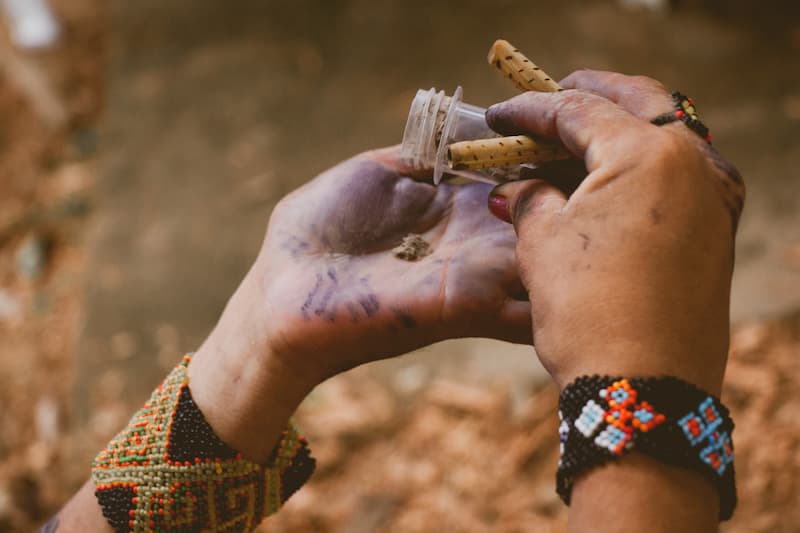
Rapé is a powdered shamanic snuff made from various Amazonian plants and blown forcefully into the nostrils through a pipe, either by yourself or by someone else. The main ingredients are Nicotiana rustica, a potent tobacco, sometimes other tobacco varieties, and various medicinal Amazonian plants. Most blends contain nicotine along with other alkaloids that have powerful effects on body and mind. Nicotine works as both a stimulant and a depressant in complicated ways. Other alkaloids in these preparations may be anti-inflammatory, anesthetic, or antimicrobial.
Short term effects include a hard burning sensation in the nose and throat, watering eyes, increased heart rate and body temperature, dizziness, nausea, and altered states of consciousness. The acute part passes in roughly five to twenty minutes, with a longer tail after that.
As an entheogenic medicine, rapé can open access to spiritual planes of consciousness. It can connect a person with God. Many people work with it for prayer, for connection to the divine, and as an ally in physical, emotional, mental, and spiritual healing. There is no denying the power of this medicine and I am not trying to diminish it. To me rapé is an extremely powerful medicine that demands respect and is not something to play with casually.
One piece of chemistry sits underneath everything below. Hand-made rapés carrying alkaline tree ash tested at pH 9.75 to 10.2, which puts around 98 to 99 percent of their nicotine in the free base form, the form that crosses membranes fastest (Stanfill et al., Food Chem Toxicol, 2015). The commercially manufactured blends in that same analysis were mildly acidic and delivered only a small fraction of their nicotine as free base. The traditional preparation is the harder-hitting one, and the ash is the reason.
Nicotine poisoning: a real risk
Nicotine toxicity is one of the primary risks with rapé and it is rarely discussed. Some of what we experience as purging and cleansing is the body responding to a toxic dose. At high enough doses the body clears it by vomiting and defecating. Nicotine poisoning can also cause seizures, and in high enough doses it can kill.
The lethal dose is worth getting right, because the figure in general circulation is wrong. Textbooks and safety sheets have long put it at 30 to 60 mg for an adult. Bernd Mayer traced that number through circular citations back to a 1906 textbook by Rudolf Kobert, resting on nineteenth century self-experiments, and found it conflicted with other data available even then. Evidence from actual fatalities and from animal work puts the lower limit for a fatal oral dose closer to 500 to 1000 mg, roughly 6.5 to 13 mg/kg (Mayer, Arch Toxicol, 2014). There are many records of people surviving far more than 60 mg, including one documented survival after four grams. Children are genuinely more vulnerable and small amounts matter for them, though the specific pediatric figure in circulation comes from the same shaky lineage.
The nicotine in rapé itself has been measured. Tobacco-containing blends ran from 0.67 to 5.09 percent by dry weight, which is about 6 to 51 mg per gram. Rustica leaf on its own can reach around 9 percent, but the finished snuff is cut with ashes and other plants.
Run the arithmetic on an actual dose and it is sobering without being apocalyptic. Vendors tell beginners to start with a dime-sized amount, a fraction of a gram, so one administration of a strong blend delivers something in the range of ten to twenty-five milligrams of nicotine. A cigarette delivers one to two. That is a large dose landing on a mucous membrane in seconds, and it is more than enough to make a first-timer very sick, particularly someone with no tolerance. At ordinary ceremonial doses it is not enough to kill an adult. I would rather you understood the real shape of this risk than carried a scarier number that falls apart the moment somebody checks it.
Nicotine is absorbed rapidly through the nasal mucous membranes, which is a large part of why rapé hits the way it does. Its half-life is roughly two hours. Cotinine, its main metabolite, persists much longer, on the order of sixteen to twenty hours.
Early symptoms of nicotine poisoning include burning of the nose and throat, nausea, vomiting, dizziness, increased salivation, abdominal pain, diarrhea, headache, and disturbances of hearing and vision. In severe cases it progresses to difficulty breathing, irregular heart rate, seizures, collapse, and coma or death from respiratory failure.
The state of the evidence
Rapé is badly under-studied, and it is worth being clear about that rather than papering over it.
The clinical literature on acute nicotine toxicity is substantial, but it is built almost entirely on e-liquids, nicotine gum and patches, insecticides, and occupational exposure. Amazonian snuff barely appears in it. The 2015 chemical characterization I keep citing describes itself as the first report of nicotine, toxicants, carcinogens, and flavor compounds in these products, and very little has followed it in the decade since.
That silence is not reassurance. It is a gap, and there are reasons for it. Nobody is systematically collecting adverse events out of ceremony spaces. People who get hurt in them tend to interpret what happened spiritually rather than medically, and they never present anywhere that would generate a record. The facilitator who was there has every incentive to read a seizure as a purge or a release. So the events happen and the paper trail does not.
What I have instead is what walks into my practice, and I have seen enough of it to keep writing about this.
Hepatotoxicity
Liver injury does not come up much in connection with rapé, and there are mechanisms worth laying out.
Nicotine metabolites concentrate in the liver, and frequent heavy use means a repeated load on the same pathway. But the more interesting finding is in the flavor chemistry. Several tested blends contained milligram quantities of coumarin, along with camphor and eugenol, and the authors flagged those specifically as warranting evaluation (Stanfill et al., 2015).
Coumarin is a known hepatotoxin. The European Food Safety Authority set a tolerable daily intake of 0.1 mg per kilogram of body weight, about 6 mg a day for a 60 kg adult, and the human clinical data revealed a subgroup considerably more susceptible than the animal studies predicted (Abraham et al., Mol Nutr Food Res, 2010). Coumarin comes from tonka bean, which is cumaru, which is sold as a rapé ingredient right now.
There is a second layer here that I think matters more than the first. Coumarin is detoxified primarily by CYP2A6, and CYP2A6 is also the enzyme responsible for the large majority of nicotine clearance. You are putting two substrates for the same enzyme up your nose at the same time. And the people with reduced CYP2A6 activity are the same people who clear nicotine slowly and who accumulate coumarin’s hepatotoxic metabolite. That is a group who will experience the same dose as a much bigger dose, on both counts at once.
Worth noting for anyone combining medicines: nicotine clearance runs through CYP2A6 specifically. Harmine and harmaline, the principal alkaloids in ayahuasca, are potent MAO-A inhibitors and they inhibit CYP3A4 and CYP2D6, but CYP2A6 is not among their targets. There are real reasons for care when combining these medicines, and I have written about what harmine does to the P450 system separately. Impaired nicotine clearance is not one of them.
Summary of potential health risks
Rapé contains variable but real levels of nicotine and other alkaloids, enough to produce acute toxicity including nausea, vomiting, and in severe cases seizures and respiratory compromise. Regular use produces dependence, which I have written about at length. The measured samples contained tobacco-specific nitrosamines and polycyclic aromatic hydrocarbons that IARC classifies as known or probable carcinogens. Long-term nasal snuff use is associated with chronic rhinitis and with tissue changes in the nasal lining. And ceremonial administration means forceful insufflation onto a highly vascular membrane, which raises absorption and therefore raises everything downstream of absorption.
Mechanisms of injury
Nicotine is toxic at high doses, and its worst effects run through nicotinic receptors at the neuromuscular junction, which is the road to respiratory failure. The alkaline ash in traditionally prepared blends shifts nicotine into its free base form and speeds absorption dramatically. Other alkaloids in the tobacco, including nornicotine, anabasine, and anatabine, are nicotinic agonists in their own right and add to the total load. Coumarin and the other flavor constituents present in milligram quantities deserve evaluation on their own terms, and they compete for the same enzyme that clears the nicotine. Heavy use means repeated exposure to the carcinogens in the material.
Where mineral status enters this, and where I do have direct experience, is in how differently people handle that load. Detoxification is enzyme work, enzyme work is mineral dependent, and most people arriving at these ceremonies are running on depleted reserves. I do not think that is the only thing separating the person who has a rough night from the person who has a seizure. I would not leave it out either.
Social harms
There are other harms I have not covered here, including what addiction does to relationships. I wrote about that in Addiction Culture in the Plant Medicine World.