This piece was originally published on my Substack on June 2, 2025. If you’d like to follow my writing there, you can find me at mineralshaman.substack.com.
Something has been bothering me about the alternative health world lately.
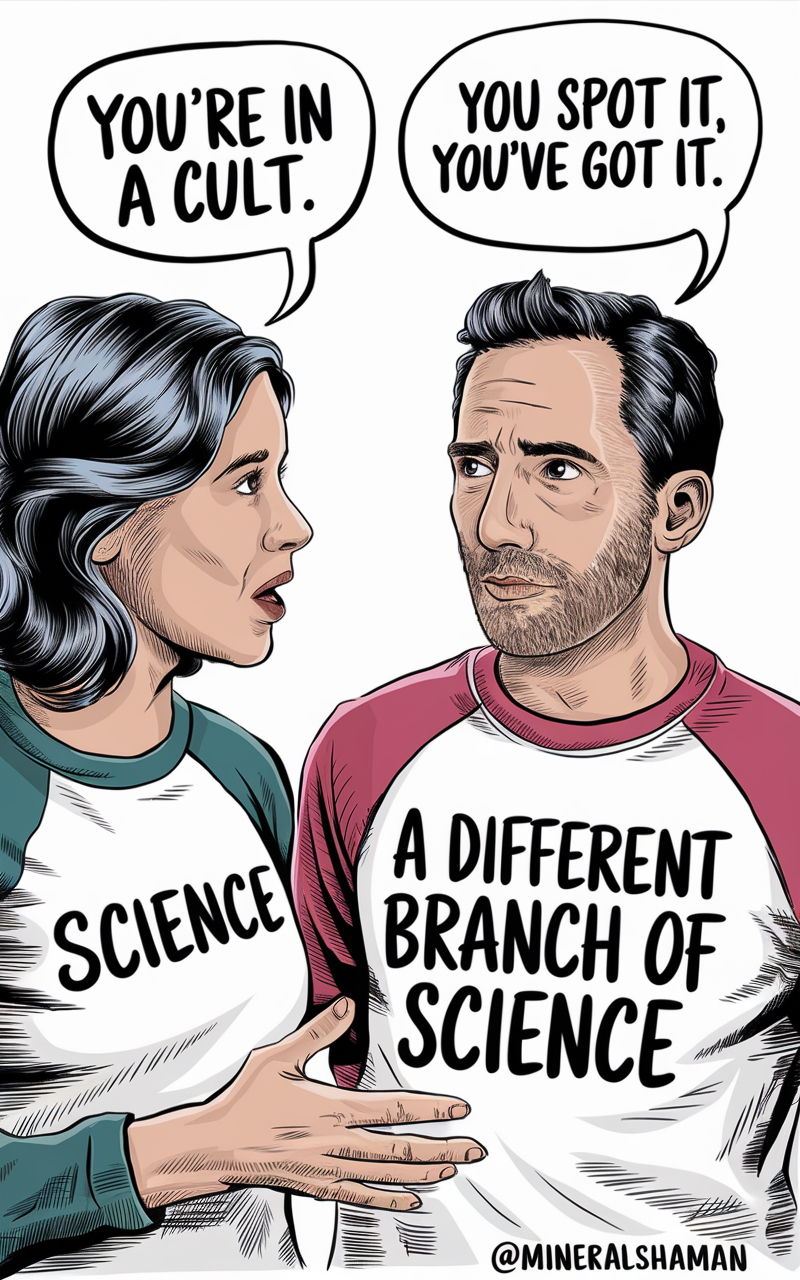
People are calling everything a cult.
One branch of mineral balancing calls another branch cultish. Someone explores German New Medicine and gets told they’ve been manipulated. A practitioner questions the dominant story about copper toxicity and gets told they’re brainwashed.
The pattern is spreading.
Here’s how I think we got here. Podcasts, documentaries, and a shelf of popular books have made everyone fluent in cult vocabulary without making anyone precise with it. Stretch the definition far enough and any group holding unconventional ideas looks suspect. Any framework looks like brainwashing.
So the word became a tool for dismissing ideas that make us uncomfortable.
Disagree with someone’s reading of the evidence? Cult. That protocol didn’t work for you? Cult. Someone questions a belief you hold tightly? Cult behavior.
Problem solved. No need to engage with the idea, look at the evidence, or do the work of evaluating a claim.
Underneath the pattern, I think something protective is happening. When a fundamental belief gets challenged, a defense comes up. It isn’t rational. It’s emotional. Rather than sit with evidence that threatens a worldview, we reach for the word that ends the conversation.
Cult carries so much weight, and lands with such finality, that it stops inquiry cold. It converts a disagreement into a moral matter. You’re not merely wrong. You’re dangerous, brainwashed, either a victim or a predator.
Once the label sticks, there’s no route back. No reason to look at evidence, consider another explanation, or engage with what was actually being said.
Robert Jay Lifton had a name for this kind of language. He called it a thought-terminating cliché, a phrase built to shut thinking down rather than open it up.¹ There’s a name for the move in logic, too. Attacking the source instead of the argument is poisoning the well.²
The irony sits right on the surface. People warning others about cult tactics end up running one themselves, closing off inquiry with a label.
Most of what gets called culty isn’t a cult. It’s a paradigm. A framework for understanding how something works.
Germ theory is a paradigm. So is terrain theory. Traditional Chinese Medicine is a paradigm. So is German New Medicine. You can study these frameworks, compare them, borrow from several at once.
The difference is that a paradigm is something you can pick up and put down. You wear it like a pair of glasses, see what it shows you, and take it off if the view doesn’t hold.
When someone calls a paradigm culty, they aren’t engaging with any of that. They’re going after the people instead of the framework, which is an ad hominem and has been recognized as a bad move for about as long as people have argued in public.³
I find this hardest to accept from people who should know better. Practitioners and influencers with platforms are selling ideas and working with real human beings. That carries an obligation to intellectual honesty. Disagreeing with a paradigm is fine. Tearing one down as a cult requires that you first understand what you’re tearing down.
What usually happens instead is a straw man. Someone with influence, believing they understand a framework, misstates its central reasoning, attacks the version they just built, and then applies the cult label to a premise of their own construction.
This does three kinds of damage.
It makes us worse at recognizing groups that are actually dangerous. When everything unconventional reads as culty, the signal disappears into the noise and we lose the ability to tell real coercion from ordinary disagreement.
It shuts down the inquiry that moves anything forward. Most significant breakthroughs came from someone willing to question a dominant paradigm. Label that questioning as cult behavior and curiosity dies with it.
And it’s unfair to people who survived the real thing. Their experience deserves serious attention. Throwing the word around to describe anyone with different beliefs cheapens what they lived through.
There’s a related pattern I keep seeing, where someone systematically dismantles the people who tried to help them. First the teacher or the framework gets idealized. Then reality fails to match the fantasy and the whole thing inverts. The weapon of choice is an accusation of coercive control. A teacher held a boundary, so it becomes control. The results didn’t arrive, so it becomes manipulation. The move borrows the protection we rightly extend to genuine victims and uses it to avoid both the ideas and any responsibility for one’s own experience.
We could ask better questions. Does this framework explain what we’re seeing better than the alternatives? What evidence supports it, and what contradicts it? How does it handle data that doesn’t fit? What actually happens when people apply it?
Those questions are about substance. The label is about character.
The practitioner exploring terrain theory isn’t in a cult. They’re working from a different paradigm, and their conclusions might be wrong, right, or partly useful. We won’t find out by dismissing them.
I’ve had this aimed at me. Years of reading about copper led me to question the toxicity narrative, not because anyone got to me, but because I haven’t found the evidence convincing. When I read respected doctors asking whether the heart functions solely as a pump, I’m not enlisting in a cardiac conspiracy. I’m following the argument and staying willing to change my mind.
That kind of inquiry still gets called cult behavior. The accusation tells you more about the accuser’s discomfort with uncertainty than about anything the accused is doing.
Real exploration means examining an idea without swallowing it. You can study something thoroughly and still hold your conclusions loosely.
I’ve contributed to the confusion myself. In earlier writing I joked that everyone is in a cult, meaning we all swim in inherited paradigms the way fish swim in water. It was a fair observation and a sloppy sentence. It blurred the line between exploring a framework and being subjected to coercive control. I should have been more careful then. I’m trying to be now.
A lot of people are questioning a lot of established paradigms right now. That questioning is healthy. The problem isn’t the questioning. It’s whether we can still think clearly about what we’re looking at.
If we can’t tell paradigm exploration from actual coercion, we can’t protect anyone from anything. When everything is a little bit culty, nothing registers as dangerous.
That isn’t discernment. It’s paralysis wearing discernment’s clothes.
We can do better than this. We can meet ideas on their merits instead of reaching for a phrase designed to stop the conversation. We can distinguish between a framework for understanding reality and a system built to control people.
This is more than a quarrel about semantics. Clear thinking runs on precise language, and right now we’re losing both.
References
¹ Lifton, R. J. (1961). Thought Reform and the Psychology of Totalism: A Study of “Brainwashing” in China. New York: W. W. Norton.
² Walton, D. (1998). Ad Hominem Arguments. Tuscaloosa: University of Alabama Press.
³ Hamblin, C. L. (1970). Fallacies. London: Methuen.